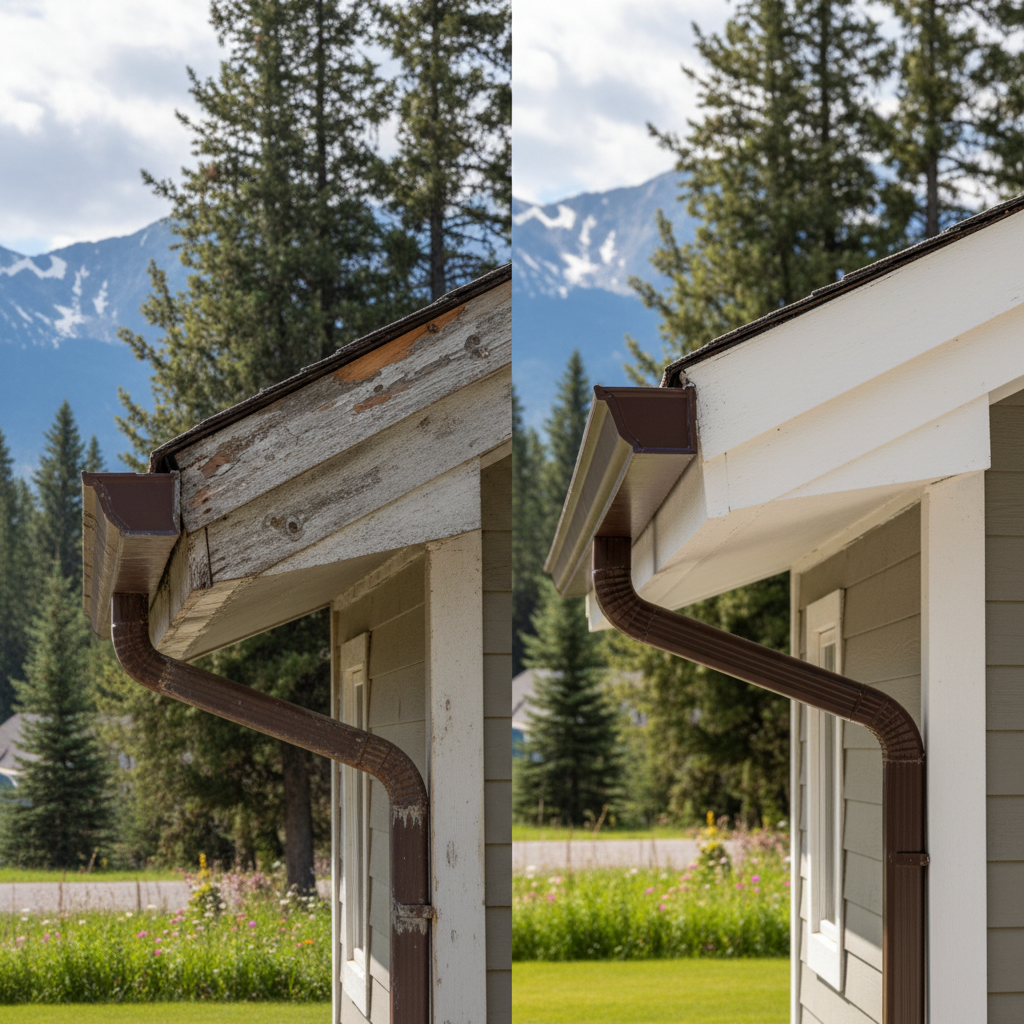
Your fascia boards really take a beating, especially here in Whitefish. Think about it: heavy snow, brutal freeze-thaw cycles, and the occasional critter trying to snuggle in. No wonder they sometimes look a little rough around the edges. When you spot rot, cracks, or peeling paint, the big question always pops up: do I just patch it up, or do I replace the whole thing?
I’ve seen a lot of fascia over the years, from the older homes in our historic downtown to the newer places up on Big Mountain. And I can tell you straight, there’s a right way and a wrong way to handle this. It really depends on the damage and what you’re hoping to get out of the fix.
Option 1: The Patch Job (Surface Repair)
This is usually the first thing people consider. Why? Because it seems like the cheapest, quickest way out. A patch job means cutting out just the visibly damaged part of the fascia, usually a smaller section, and then putting in a new, matching piece of wood. After that, you fill, sand, prime, and paint.
The Good:
- Lower Upfront Cost: You’re buying less material, and it takes less labor time. If it’s truly just a small, isolated spot, this can save you some cash right off the bat.
- Faster: A small patch often gets done in just a few hours, though you do have to factor in paint drying times.
- Less Disruptive: You aren’t tearing down long sections of board, so there’s less mess. Plus, it won't impact your landscaping or daily routine as much.
The Not-So-Good:
- Durability is a Gamble: This is the big one, folks. If the rot or damage is only on the surface and hasn't spread, a patch *might* hold. But often, what you see is just the tip of the iceberg. Wood rot is tricky like that; there's usually more going on underneath than what you can see. If you don't fix the root cause (like a leaky gutter or ice damming), that patch will just rot again, probably even faster than the original board did.
- Appearance Can Be Tricky: Matching wood grain, getting those seams perfectly smooth, and making the paint blend seamlessly can be tough. You might end up with a repair that really stands out.
- Short-Term Fix: In our climate, a patch often buys you a few years, not decades. You could be right back where you started sooner than you think, meaning you'll spend more money in the long run.
Option 2: Full Section Replacement
This approach means taking out the entire length of fascia board that’s damaged, or even the whole run along one side of your house, and putting in brand new material. It’s a much more thorough repair.
The Good:
- Long-Term Durability: When you replace a full section, you're getting rid of all that potential hidden rot and starting fresh. You also get to inspect the rafter tails and sub-fascia underneath, which is super important. If those are messed up, a patch won't do a thing.
- Better Appearance: New, continuous boards just look cleaner and more uniform. No patchwork lines or mismatched textures here.
- Opportunity for Upgrades: This is your chance to use better materials. Maybe you switch from standard pine to a more rot-resistant cedar, or even a composite material that holds up better to moisture. You can also make sure proper flashing and drip edges are installed to stop future water damage.
- Real Confidence: You know the job’s done right, and you won’t be worrying about that section of fascia for a good, long time.
The Not-So-Good:
- Higher Upfront Cost: More materials, more labor. There’s no getting around it; this will cost more initially than a patch.
- More Time and Disruption: Taking out and replacing entire sections just takes longer.
- Potential for Hidden Surprises: While it’s good to uncover issues, sometimes removing the fascia reveals more extensive damage to the roof decking or rafter tails. That can mean additional, unexpected costs.
My Recommendation for Whitefish Homeowners
Look, I get it. Nobody wants to spend more money than they absolutely have to. But when it comes to fascia in a place like Whitefish, where we deal with significant moisture, heavy snow, and big temperature swings — well, I almost always lean towards full section replacement.
Here’s why: Our weather is relentless. A small patch might seem fine for a bit, but if the wood around it is already compromised by moisture or has started to wick water, that patch is just going to fail. You’ll end up paying for a patch now, and then paying for a full replacement later. That’s just throwing good money after bad, isn't it?
When we’re up there installing new gutters, or even just cleaning for a customer, we often spot fascia issues. If it’s anything more than a tiny, superficial ding, I’m going to recommend replacing the whole board. It’s the only way to truly solve the problem, protect your home’s structure, and give you a repair that actually lasts. Plus, it gives us a chance to make sure your gutters are perfectly aligned with the new fascia, ensuring water drains exactly where it should. At Aim High Gutter Co, we’re all about doing it right the first time, and that includes making sure the foundation for your gutters – your fascia – is solid.
Think of it as an investment. A proper fascia replacement protects your roof, your soffits, and the structural integrity of your home from water damage. In the long run, it’s going to save you headaches and a lot more money than trying to band-aid a bigger problem.